Advancing Knowledge.
Inspiring Growth.
We are committed to advancing knowledge and encouraging scholarly dialogue across a wide range of disciplines. We provide a trusted platform for sharing high-quality research and original ideas, reflecting our dedication to academic excellence and intellectual growth.
 Google Scholar





Why Authors Choose Our Journals
Dedicated to rigorous scholarship, author rights retention, and global research discoverability.

Rigorous peer review
Double blind peer-review by qualified reviewers across fields to ensure impartial, constructive evaluation.
Open access
All our Journals are free to read worldwide the moment it is published under CC-BY 4.0 licence.
Permanent DOI
Every published paper is assigned a DOI from Crossref, ensuring permanent citation links and metadata harvesting.
Multidisciplinary scope
Open to research across the Social sciences, humanities, and allied fields on a continuous rolling basis.
Transparent, Sustainable Open-Access Publishing
To sustain peer review management, copyediting, Crossref DOI registration, and global digital preservation, a modest single publication fee applies.
Waivers and Discounts: We consider waiver or discount requests on a case-by-case basis, particularly for authors facing financial hardship and from developing countries. Requests should be made to the editorial office at the point of submission.
Our Journals
Peer-reviewed academic journals across the arts, humanities, political studies, critical perspectives, and multidisciplinary research.
 Arts & Humanities
Existentia: Concrescence Journal of Arts and Humanities
Critical inquiry, cultural philosophy, historical studies, literary criticism, and creative theoretical discourses.
 Multidisciplinary
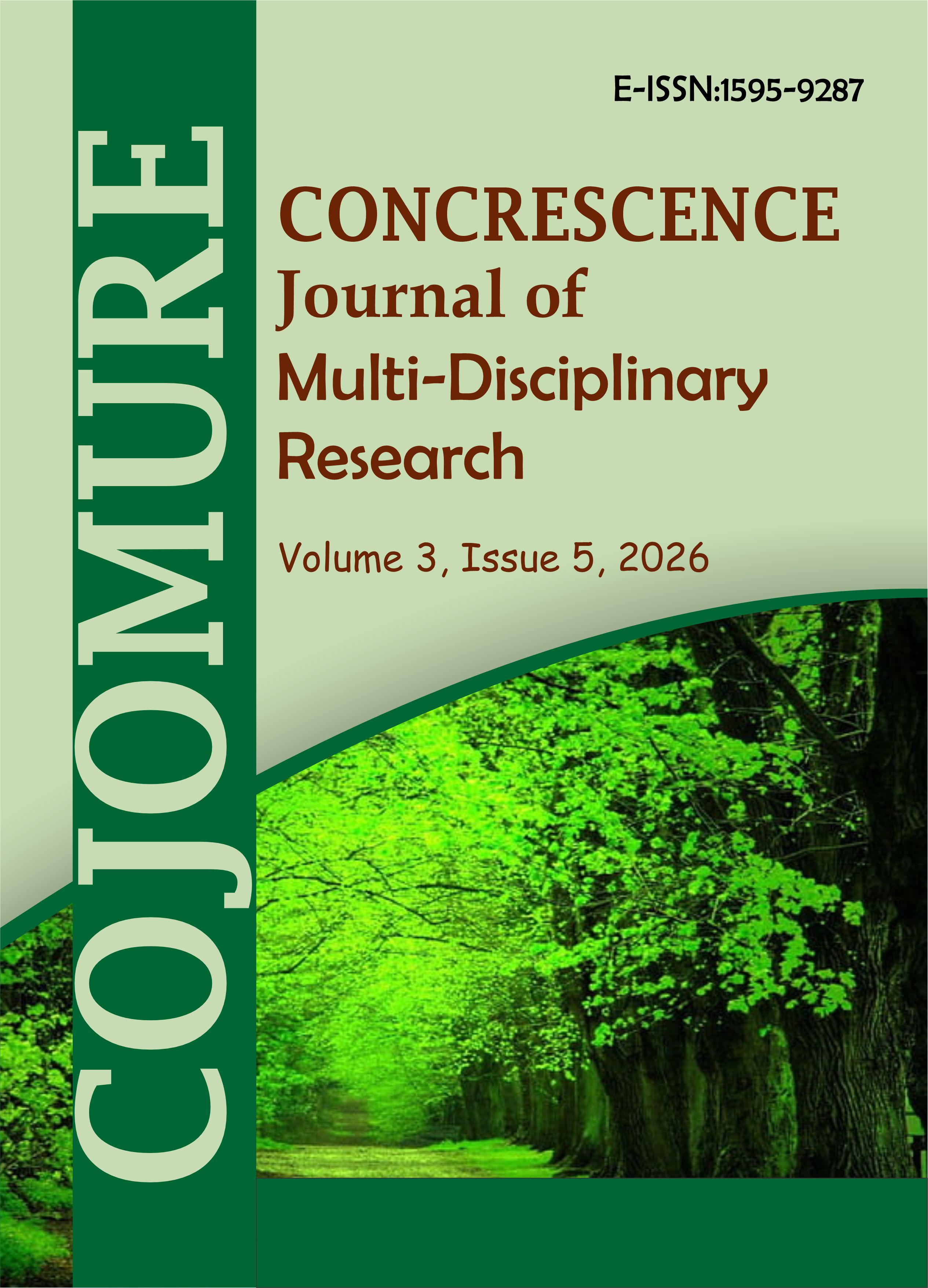
Concrescence Journal of Multi-Disciplinary Research
Cross-disciplinary research, methodological innovation, and original scholarship bridging social sciences, humanities, and empirical sciences.
 Critical Perspectives
Izu: Journal of Critical Perspectives
Peer-reviewed critical scholarship and interdisciplinary theoretical perspectives.
 Political Studies
The Polis: Journal of Political Studies
Scholarly analysis of political theory, public policy, governance systems, international relations, and civic institutions.
How to Publish Your Paper
A clear, transparent six-stage editorial workflow from initial submission to global online publication.
Submit
Submit your manuscript and author details through the online submission form. Initial submission is completely free with no fee required to begin review.
Peer Review
Qualified reviewers review your paper and return a decision. All evaluations are conducted via double-anonymised assessment to guarantee fairness and rigour.
Acceptance
On acceptance, confirm your details and complete the copyright form. Authors retain full copyright under Creative Commons Attribution (CC-BY 4.0).
Processing
Complete any applicable publication charge (₦30,000 for Nigerian authors / US $90 for foreign authors). Eligible waivers are applied as approved.
Publication
Your paper is published online with a permanent Crossref DOI assigned, downloadable PDF, and automated distribution to indexing databases.
Online-Only Publication
All our Journals are published online only. Immediate open access allows researchers, practitioners, and students worldwide to access your work unrestricted.
Influence of Financial Technology Knowledge on Entrepreneurial Competence among Business Education Students in Colleges of Education in Oyo State
Entrepreneurial competence increasingly depends on the ability to use digital financial technologies to identify opportunities, manage resources and conduct business transactions. This study examined the association between Financial Technology (FinTech) knowledge and entrepreneurial competence among Business Education students in Colleges of Education in Oyo State. A descriptive-correlational survey design was adopted. The population comprised 526 Business Education students from 420 Federal College of Education (Special), Oyo, and 106 Oyo State College of Education, Lanlate. A sample of 227 students was determined using Taro Yamane’s formula at 5% precision. Data were collected with a structured questionnaire and analysed using mean, standard deviation and simple linear regression. The results indicated a high self-reported level of FinTech knowledge (M = 3.45, SD = 0.59) and entrepreneurial competence (M = 3.46, SD = 0.70). Regression analysis showed a statistically significant positive association between FinTech knowledge and entrepreneurial competence (R = .582, R² = .339, F(1, 225) = 115.26, p < .001; B = .624, β = .582, t = 10.74, p < .001). FinTech knowledge accounted for 33.9% of the observed variance in self-reported entrepreneurial competence. Because the study used a cross-sectional survey and self-reported measures, the results should be interpreted as an association rather than evidence of causation. The study recommends strengthening practical FinTech education, including digital payments, digital financial records, cybersecurity and emerging financial technologies, in Business Education and entrepreneurship programmes.
Indexing & Discoverability
Connecting your published scholarship to worldwide bibliographic databases, citation networks, and open research search engines.
Google Scholar
Comprehensive academic search & citation metrics
Crossref
Persistent DOIs & machine-readable metadata
OpenAlex
Global open knowledge graph & bibliometrics
Scilit
Scientific literature automated indexing crawler
Semantic Scholar
AI-driven semantic paper and citation explorer
Lens
Scholarly literature & open patent mapping
Dimensions
Linked research insights, citations & grants
Ready to Publish Your Research?
Join the scholars who trust our Journals for rigorous, open-access, peer-reviewed publication. Share your research with a community committed to knowledge and excellence.